Take a closer look at our Continuing Education courses…

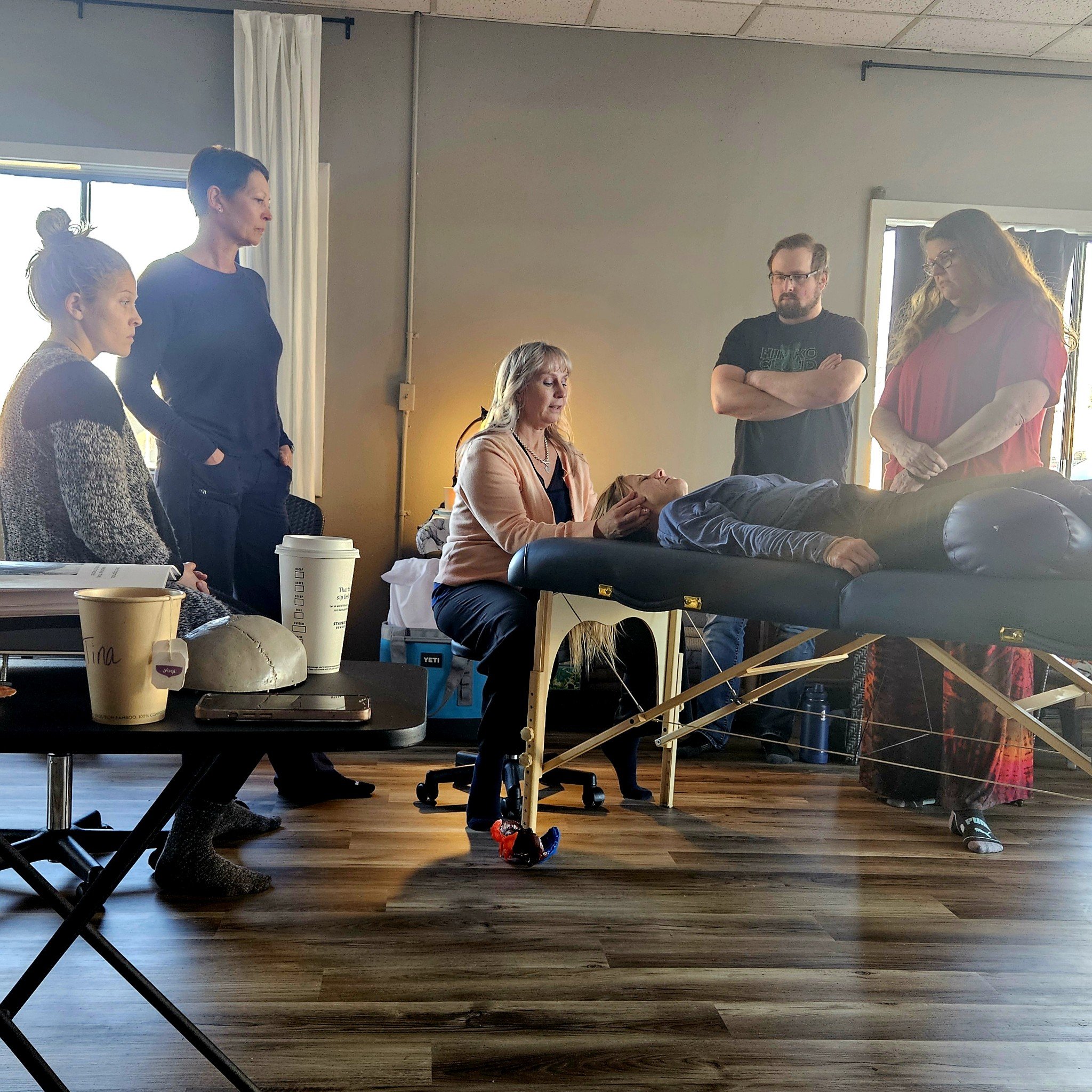
Our Continuing Education Classes
Introduction to Craniosacral Therapy
16-hour course, over two days
A grounded, practical introduction for bodyworkers who want better results without working harder
Most people who sign up for this class are feeling burned out, uninspired, or ineffective in their practice — sometimes all three. Many are tired of relying on deep tissue techniques that exhaust their bodies without consistently helping their clients. Others are newer massage therapists who’ve heard about craniosacral work and are curious, hopeful, and looking for something that actually makes sense in real sessions.
This course is especially valuable for practitioners working with clients who live in a constant state of high stress — clients whose nervous systems are “jacked up,” whose muscle tension doesn’t respond well to force, and who present with chronic pain, headaches, anxiety, overwhelm, neurodiversity, or emotional patterns that aren’t being addressed effectively through massage alone.
If you’ve ever thought:
I’m working too hard
My hands are tired
I don’t know what to do when nothing changes
I feel like I’m guessing
—you’re in good company.
Many students say within the first hour of day one, “I wish I had understood this years ago,” or “I’ve wasted so much time doing deep tissue.”
What this class actually teaches
In this Introduction to Craniosacral Therapy course, we explore principles drawn from craniosacral work that help practitioners learn how to listen more clearly to the body’s innate rhythms and respond with precision, presence, and intention.
You’ll learn how to:
slow down without losing effectiveness
work with less force while achieving better results
recognize and support regulation in the nervous system
improve fluid movement and tissue mobility
develop a more refined, listening-based touch
This work is not about memorizing techniques for the sake of technique. Instead, we focus on understanding why certain approaches work, how anatomy informs what your hands are feeling, and how tissues relate to one another down to the smallest level. From there, your hands begin to know what to do.
Presence, listening, and practical skill
This class balances listening and technique equally. Listening tells us where to work and what may be happening. Skillful technique allows us to respond once we have that information. Neither matters much without the other.
Each day begins with focused lecture to shape how you think about the work while your mind is fresh. From there, the class is highly experiential: demonstration, guided practice, and hands-on coaching so you learn what you’re actually feeling for with your “fing-ears.”
I am deeply committed to making sure every student can feel the rhythm we are working with by the end of the first day. Once that happens, everything changes. Many students return on day two reporting better sleep, less pain, reduced anxiety, or a greater sense of groundedness simply from being worked on and witnessed at this level.
What changes after the weekend
By the end of the course, most students are surprised by how much they don’t have to work to get meaningful results.
Common shifts include:
a softer, more intentional quality of touch
slower pacing with greater confidence
less force, more clarity
increased trust in what they’re feeling
clients noticing a clear difference in sessions
I encourage students to use only craniosacral approaches for six weeks after the class whenever possible, so they can truly see what this work does in real practice. I also invite students to reach out with questions about their clients — mentorship is a critical part of learning work at this level, and I genuinely love supporting students as they integrate what they’ve learned.
Is this class right for you?
This course is appropriate for both newer and experienced practitioners. It is especially well-suited for bodyworkers who are curious, open-minded, and willing to slow down in order to work smarter.
If you need a rigid checklist or want to collect CE hours without engaging deeply, this may not be the class you’re looking for. While I do teach protocols, I frame them as maps — helpful for learning, but never a substitute for listening to the body itself. Over time, students naturally move beyond the protocol as their confidence and perception grow.
Many practitioners choose to repeat this class at a discounted rate (contact me for details about this) because there is a lot here, and each pass through the material lands differently as your hands and understanding mature. I am not stingy with what I teach.
In short
This class is a great fit for practitioners who are looking to:
rediscover inspiration in their work
get better results for their clients
support regulation and resilience in the nervous system
work with more ease and less physical strain
deepen their relationship with their hands, their clients, and their practice
If you’ve been longing for work that feels more sustainable, effective, and meaningful — this is a strong place to begin.

Lymphatic & Venous Drainage
16-hour course, over two days
A physiology-based approach to supporting circulation, inflammation, and fluid movement
Most people who enroll in this class are practitioners who feel like they could be doing more for their clients’ overall health. Many are experienced massage therapists who are tired of working hard without seeing lasting results — especially with clients who present with chronic inflammation, swelling, pain, or systemic stress patterns.
Some come curious about the recent popularity of lymphatic work. Others arrive because massage alone isn’t holding results, or because they are working with post-surgical clients and want a safer, more effective way to support recovery. This class also attracts therapists who are looking for gentler work that supports career longevity without sacrificing clinical effectiveness.
Why lymphatic and venous drainage matters
This course addresses a major blind spot in most lymphatic trainings: the role of venous drainage and return pathways.
Rather than focusing on lymph in isolation, we examine how the lymphatic and venous systems function together, and how improving venous return reduces demand on the lymphatic system as a whole. This perspective is rooted in time-tested bodywork principles that long predate modern lymphatic trends, emphasizing the importance of opening pathways away from tissues before encouraging increased flow toward them.
Students learn how to think differently about circulation — not as something to “force,” but as something to support through sequencing, anatomy, and physiology.
What this class helps with
This work is particularly helpful for clients who present with:
swelling or edema
chronic inflammation
a feeling of heaviness, congestion, or puffiness
fibromyalgia or inflammatory pain patterns
autoimmune or systemic inflammatory conditions
post-surgical recovery (medical and cosmetic)
sensitivity or flare-ups following traditional massage
Many students report that prior to this class:
massage helps briefly, then symptoms return
clients feel worse after deeper work due to inflammation
swelling and congestion feel confusing or intimidating to address
fluid dynamics weren’t clearly taught in school
It’s common to hear students say early on, “I never learned this,” or “This explains so much about why my work hasn’t been holding.”
How students change after the weekend
After the course, students have a clearer, more grounded understanding of how circulation works — both on and off the table. They leave with a logical, full-body protocol for lymphatic and venous drainage that can be used immediately in practice, along with a framework for deciding when and why this work is appropriate.
Touch becomes:
significantly lighter
slower and more intentional
more confident, even when pressure is minimal
For many students, the first day challenges their assumptions about effectiveness. By the second day, most have had a personal experience of improved elimination, better sleep, or a general sense of lightness — and the work starts to make sense in their own bodies.
Clients often report:
feeling lighter and less congested
reduced swelling
less pain without deep work
improved recovery between sessions
greater tolerance to other therapies
By the end of the weekend, most students are surprised that such light strokes can create meaningful changes in a client’s overall health.
How this class is taught
Each day begins with focused lecture to establish a clear understanding of anatomy, physiology, and sequencing. From there, the class is highly hands-on, with demonstration, guided practice, and direct coaching to help students learn how light is light enough.
Pressure is taught with specificity — often described as similar to the touch you’d use over a closed eyelid — so students can trust that they are working effectively without digging into tissue.
While the class includes a defined sequence, it is taught logically rather than mechanically, helping students understand why each step matters. This work stands on its own and is not intended to be layered into a traditional massage session.
Is this class a good fit for you?
This course is appropriate for both newer and experienced practitioners, particularly those who are curious, willing to slow down, and interested in physiology and circulation.
It may be frustrating for therapists who:
only want to work deeply
equate pressure with effectiveness
are unwilling to change long-held habits
This class is a great fit for practitioners who want to help their clients improve health at a foundational level — recognizing that effective circulation to and from tissues is essential for function, regulation, and long-term results.
In short
This is a subtle, powerful class that earns its place in a sophisticated clinical skill set. It asks practitioners to think differently, work more efficiently, and trust physiology rather than force. While the work itself is quiet, the outcomes often speak loudly — sometimes weeks later, when clients report changes no other approach had produced.
Balancing the Diaphragm & Ribcage
24-hour course, over three days
What if the place you need to work isn’t where your client hurts?
The diaphragm is one of the most important muscles in the human body—and one of the muscles bodyworkers typically learn the least about.
Think about it for a moment: Do you have a clear picture of the diaphragm in your mind? Can you palpate it? Can you feel how it moves? Can you recognize when its movement is restricted or when the ribcage isn’t moving as it should?
If the answer is no, you’re not alone.
And you may be missing one of the most powerful pieces of the puzzle when working with clients who have persistent pain, recurring strain patterns, limited mobility, or problems that just don’t seem to respond to the things you’re doing.
The diaphragm sits at the center of an extraordinary system of movement and pressure throughout the body. It influences the relationship between the thorax and abdomen, contributes to circulation and fluid movement, and is intimately connected with the ribs, sternum, thoracic spine, neck, and many of the muscles involved in breathing.
Its influence doesn’t stop at the ribcage.
Through the mechanical relationships of the body, restrictions in this region can be associated with patterns involving the pelvis, hips, knees, shoulders, neck, and jaw.
That means a client with recurring knee pain may not need more work on their knee.
They may need you to look at their diaphragm and ribcage.
Why the diaphragm matters so much
The diaphragm is far more than a muscle that helps us breathe.
It is a major fluid-pressure modulator—helping regulate pressure relationships between the cavities of the body and contributing to the movement of blood and other fluids.
Every breath creates movement.
And movement is life.
For tissues and organs to remain healthy, fluids need to move in, through, and out of them. Arterial blood needs to arrive. Venous blood needs to leave. Lymphatic fluid needs to move. The organs and tissues themselves need room to move and adapt.
The diaphragm is a major player in this process.
When its movement is restricted—or when it becomes chronically held in a shortened or contracted position—the effects can extend far beyond breathing mechanics.
From an osteopathic perspective, altered pressure relationships and restrictions in one region can create compensations throughout the body. The diaphragm’s attachments and relationships help explain why a restriction here can show up as a problem somewhere that seems completely unrelated.
This is where things get really interesting for bodyworkers.
The “Why” Behind the Pain
Have you ever had a client who:
keeps coming back with the same knee problem
has chronic hip or pelvic imbalance that never quite resolves
has shoulder pain that seems disproportionate to what you find locally
carries enormous tension through the neck and jaw
struggles to take a full, comfortable breath
has a ribcage that feels almost immobile
complains of headaches or brain fog
has tried everything you can think of and still doesn’t feel better
improves after a session, only to return to the same strain pattern a few days later
You may have been taught to chase the symptom.
This class teaches you to look at the relationships.
The diaphragm connects the thorax to the abdomen. Its attachments reach into the lumbar region, and its movement is inseparable from the movement of the ribs, sternum, thoracic spine, and secondary muscles of respiration.
When those structures aren't moving well together, strain is driven into other areas.
Sometimes those strain patterns become the pain and dysfunction you keep treating.
What this class actually teaches
This is not simply a class on how to “release the diaphragm.”
You will learn the anatomy, mechanics, relationships, and hands-on assessment skills necessary to understand what you are actually feeling beneath your hands.
We will explore:
detailed anatomy and palpation of the diaphragm
the mechanics of diaphragmatic breathing
the relationship between the diaphragm and ribcage
the sternum and thoracic spine
the secondary muscles of respiration
pressure relationships within the thorax and abdominopelvic cavity
relationships between the diaphragm and the pelvis
connections to the hips and lower extremities
relationships to the shoulder girdle, neck, and jaw
how restrictions in one region can create strain patterns elsewhere
hands-on techniques for improving mobility and balance throughout the system
You will learn not only where to put your hands, but what your hands are feeling for.
Because technique without understanding becomes another protocol to memorize.
Understanding gives you the ability to adapt.
Why three days?
Because this is not a muscle you can fully understand in a quick weekend overview.
The diaphragm is complex. Its anatomy is complex. Its relationships are complex. And learning to palpate it effectively requires time.
You need time to see it, understand it, find it, feel it move, recognize when it isn't moving well, and then learn how to influence that movement without simply forcing it.
We will spend time working with the diaphragm itself, but also with the structures that surround and support it—the ribs, sternum, thoracic spine, and secondary muscles of breathing.
By the end of the three days, you should have a completely different picture of the center of the body.
And once you can feel it, you can start asking a much bigger question:
“What is this pattern connected to?”
From symptom chasing to understanding relationships
One of the things I love most about this type of work is that it encourages curiosity.
If the knee keeps hurting, why?
If the shoulder keeps tightening, why?
If the neck is constantly compensating, why?
If the pelvis never seems to stay balanced, why?
The answer isn't always local.
The body is not a collection of separate parts. It is a living system in which movement in one area affects movement somewhere else.
The diaphragm is an incredible example of this.
When it moves well, it contributes to the normal movement of the thorax and abdomen and helps support healthy circulation and fluid dynamics. When its movement is restricted, the rest of the body may have to find another way to accomplish the movements and pressure changes that normally happen with respiration. This can look like blood pressure changes, inflammation, digestive and reproductive mischief, and so many other things.
What changes after this class
My goal is for you to leave this weekend looking at your clients differently.
Not because you have learned another list of techniques, but because you have gained another way of seeing the body.
You may begin noticing:
strain patterns that make more sense
connections between seemingly unrelated complaints
restrictions you previously overlooked
more opportunities to work with the source of a pattern rather than chasing symptoms
greater confidence palpating the ribcage and diaphragm
improved awareness of breathing mechanics
more precise and effective hands-on work
a deeper appreciation for how movement supports health
And perhaps most importantly, you will have another question available to you when a client presents with a problem that doesn't make sense:
“What am I not looking at?”
Is this class right for you?
This class is designed for bodyworkers who already have a foundation in anatomy and hands-on work and are ready to take their understanding of the body to a deeper level.
It is especially valuable for practitioners who find themselves working with chronic, recurring, or complicated patterns and want to understand the relationships that may be contributing to them.
You don't need to abandon the techniques you already know.
You need to understand when something else may be missing.
If you're curious about anatomy, fascinated by the way the body connects, and willing to slow down enough to actually feel what is happening beneath your hands, I think you're going to love this class.
Because once you understand the diaphragm, you start seeing the body differently.
And once you can feel how the pieces move together, you have a whole new set of possibilities for helping your clients.
Movement is life.
And the diaphragm is at the center of it.
